Signature
The South: Monasteries & Wine
7 days
2,400 m
Vorotan gorge, Syunik — Here geology does the work of an architect: hot springs have raised a stone bridge across the Vorotan and roofed the river with their own mineral crust — a span no engineer drew and no hand set, waiting deep in the Syunik gorge.
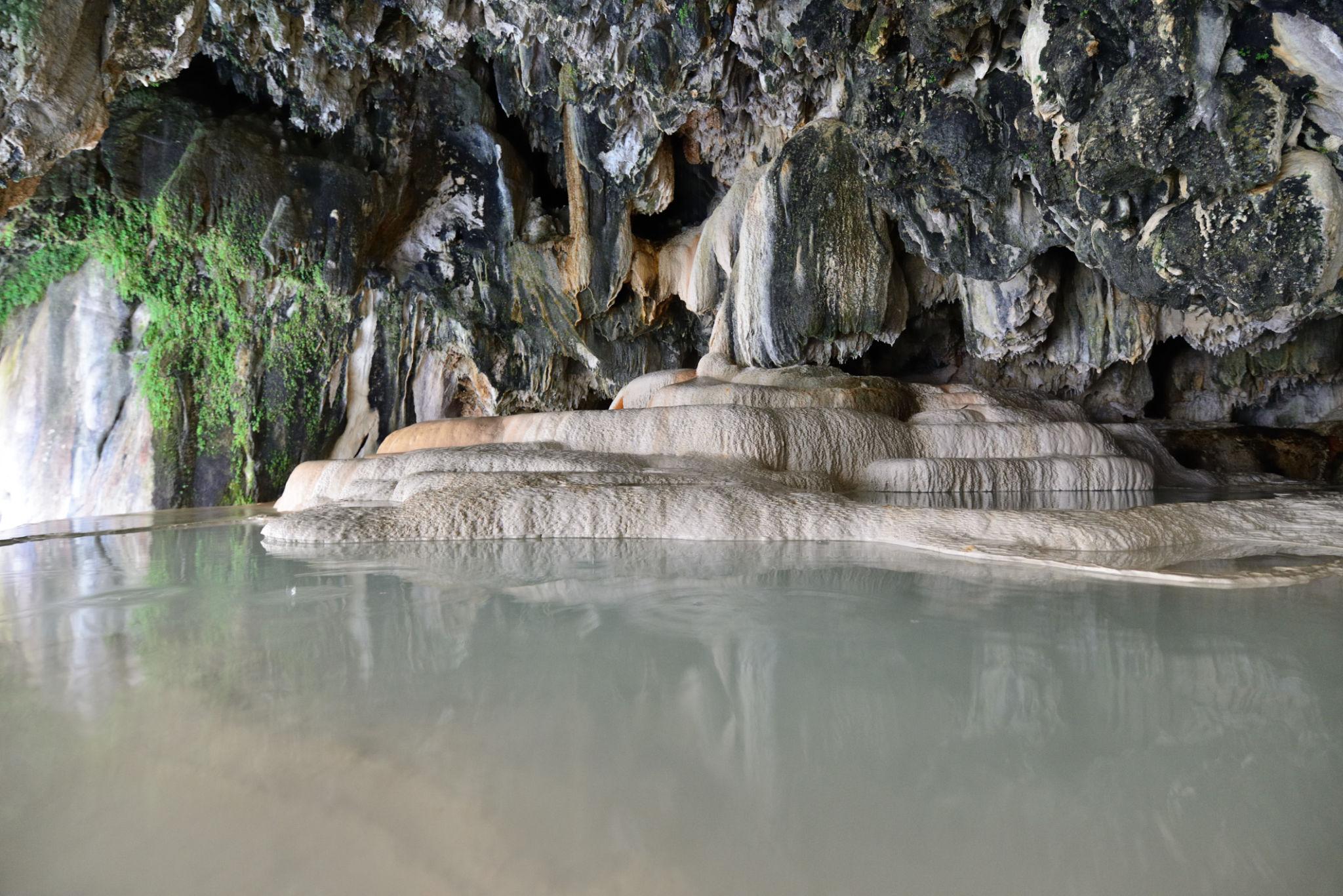
Not far from Tatev, a natural travertine bridge has formed over the 700–800 metre deep Vorotan gorge — laid down layer by layer by hot mineral springs. The water has stained the rocks pink, yellow and green; in warm pools (around 25 °C) you can bathe beneath overhanging stalactites. So unreal is the formation that locals believed only the devil himself could have made it.
The bridge sits in the Vorotan gorge on the paved road between Tatev and Aghvani, in the Syunik highlands of southern Armenia. What reads as a single rock arch is really a thick travertine crust: mineral-rich spring water has built up a bank of solid stone right across the river, broad enough to carry the road over it without anyone noticing a bridge is there at all. The real place is underneath. A short, steep path drops from the roadside down to the water, where the Vorotan slips through a low grotto and warm springs seep straight from the rock. That descent, more than the drive, is what the stop is about.
Offroad & access
Off-road factor 2 of 5: the bridge sits right on the paved Tatev–Aghvani road — no terrain, and that isn't the point here. We bring you in on the way through wild Syunik, a calm contrast between the rougher stages. The only real demand is the short, steep descent over steps and wet, slippery sinter stone down to the grotto; anyone heading for the warm basin takes it slowly.
Step onto the bridge from the road, and it takes a second to register that the firm ground under your feet is the bridge, with the Vorotan running somewhere below, out of sight. The gorge here drops 700 to 800 metres into Syunik, and the travertine crosses it in one unbroken reach.
The arch spans roughly 30 metres over the river and runs 50 to 60 metres wide — less a bridge than a short tunnel of natural stone. The water that formed it, and still feeds the grotto beneath, leaves the rock at about 25 degrees: low in salt, dense with dissolved minerals, warm enough to sit in where it gathers in natural and built basins. All of it sits at around 1,020 metres on the paved Tatev–Aghvani road, so there is no climb to reach the top of it — the whole descent is on the far side, down to the water.
The bridge was not built but grew. For thousands of years, water carrying dissolved lime has seeped from the gorge walls and shed its minerals as it cooled and slowed, laying down travertine layer on layer. Grain by grain the deposit thickened, reached out from both banks and finally closed into an arch over the Vorotan — the same slow chemistry that crusts a cave with stone, working here at the scale of a bridge. It has not stopped: the springs still run, and the rock is still gaining.
The warm, mineral-heavy water was long thought to heal, and rheumatism in particular was treated in its pools. That reputation, as much as the oddness of a bridge with no builder, is why people have climbed down to the Vorotan here for generations — to sit in water that came out of the rock already warm.
Satanayi kamurj — the Devil's Bridge. The name comes straight from the fact that no one could explain it. To the people along the Vorotan, stone did not grow, least of all across a river running hard enough to drown a man; a span that stood over the water with no mason, no scaffold and no visible seam had to be the work of something other than human hands. So they gave it to the Devil, and the name held.
The story likes one detail in particular: on one side, more water runs into the formation than ever comes out the other. Where the rest goes, the telling leaves open — taken, the older version says, by whatever raised the bridge in the first place. It is legend rather than hydrology; the water simply threads its own hidden channels through the porous travertine. But stand over a river that visibly loses more than it gives back, and you can feel how the darker explanation once took hold.
On our routes through Syunik, the Devil's Bridge is the calm beat between rougher stages — the point where the driving stops and you go down to the river on foot. It is also where the region's geology stops being scenery and turns into something you can stand inside: warm mineral water that is still, at this moment, adding stone to the rock overhead.
Because you have to earn it — the way down is short but steep, over wet, slick sinter — most people who pull off the road stay at the top and shoot it from above. Go down, and the grotto is usually quiet. You end up in the water rather than looking at it, somewhere that feels built and wild at once, before you climb back to the vehicle and carry on south. It is the stop people remember exactly because it asks a little effort of them.
Getting there is the easy part: the bridge sits right on the paved Tatev–Aghvani road at about 1,020 metres, with room to pull over and park at the roadside — no terrain, and any vehicle makes it. The effort is the descent. A short but steep path drops from the road to the grotto over steps and sinter stone that stays wet and slippery from the spray, so take it slowly and wear shoes with grip; if you mean to get into the water, budget time for the climb back up. Best season is roughly May to October — outside it, cold and ice on the descent make the drop to the water a poor idea.
SyunikMountain pass
SyunikMonastery
Syunik, Southern ArmeniaMonastery
Want to see the travertine bridge and its warm basins yourself? Armenia Expeditions plans your stop at the Devil's Bridge with enough time for the descent to the grotto. One message — we’ll plan the rest.