Signature
The South: Monasteries & Wine
7 days
2,400 m
near Goris, Syunik — Khndzoresk was a whole town before it was a ruin — homes, workshops, churches and schools worked into a gorge near Goris, busy well within living memory, then walked out of and left standing empty in the cliffs.
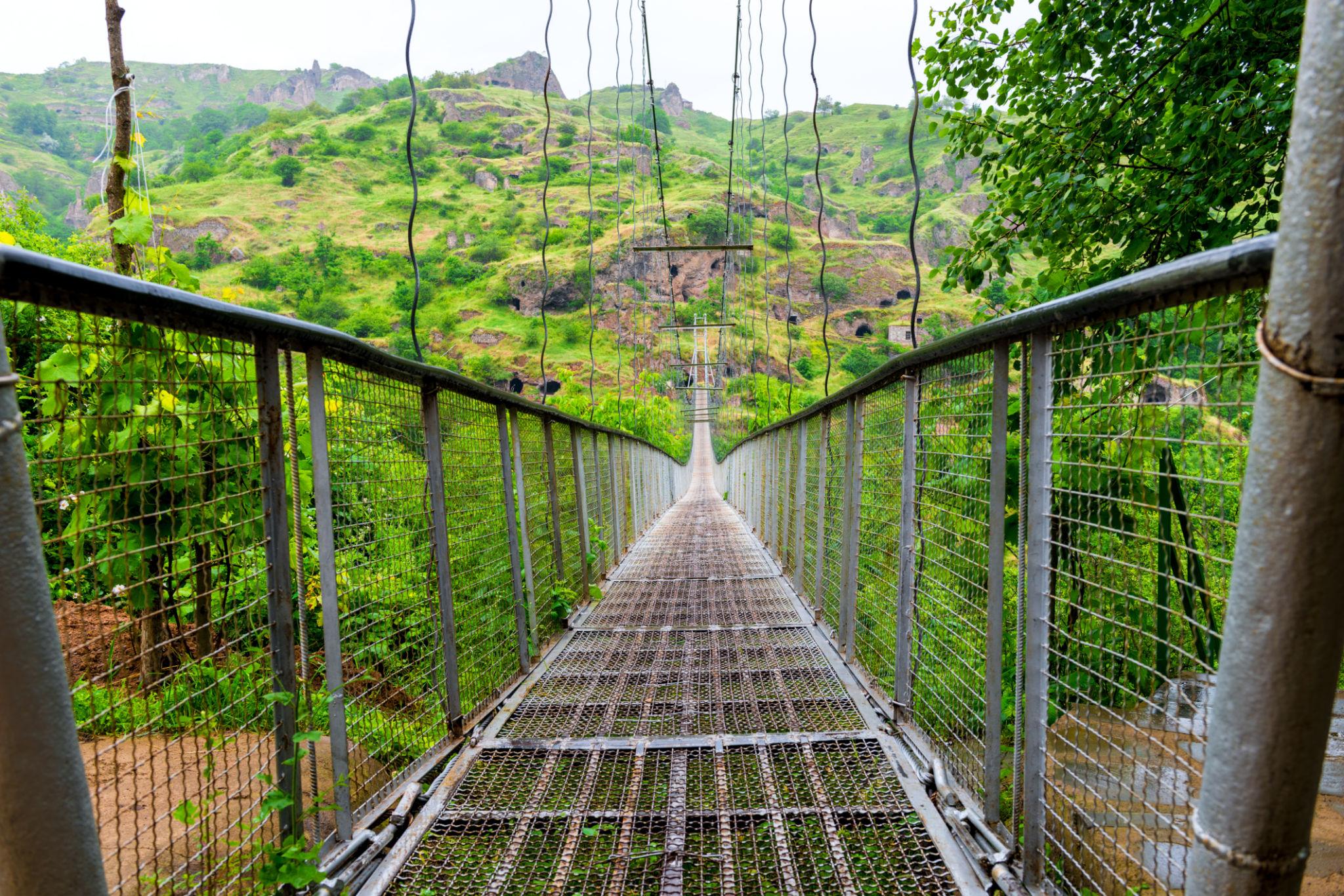
In the cliffs of a wild ravine, over 8,000 people lived in natural and hewn caves during the 17th and 18th centuries — the roof of one home serving as the yard of the next. Khndzoresk was a stronghold of the national hero Mkhitar Sparapet. Only in 1958 did the Soviets relocate its people. Today a 160-metre suspension bridge spans the gorge, swaying with every step.
Old Khndzoresk fills both walls of a deep gorge a few kilometres east of Goris, in Syunik. From the newer village on the plateau above, the ground simply falls away, and the far side reveals itself honeycombed with openings — hundreds of dwellings, some natural caves widened by hand, some cut fresh into the soft tuff, stacked in tiers up the cliff. Down on the gorge floor two churches still stand among them, along with worn paths, thresholds and low walls. It is less a single ruin than an entire abandoned townscape, and you do not take it in from a fence — you climb down into it and walk through the rooms themselves.
Offroad & access
Here the 4x4 doesn't do the work — the descent does. We bring you to the rim of the gorge; from there steep stairs drop down and across the suspension bridge, which shifts underfoot as you cross. Anyone afraid of heights will feel it. Not a driving adventure, but the calm, history-laden contrast between the hard stages of the route.
Old Khndzoresk lies in a tuff gorge just east of Goris, in Syunik, at around 1,580 metres. The settlement climbs both walls of the ravine in tiers of cave dwellings, so that, as the saying went, one family's roof was the next family's yard. Around 1913 some 8,300 people lived here, with shops, workshops, several churches and schools cut or built into the rock — a full town on a near-vertical site. It stayed inhabited until 1958, when the last residents moved up to the new village of Khndzoresk on the plateau, and the dwellings were left as they stood. The suspension bridge that now links the two sides of the gorge is recent, put up by locals in 2012: about 160 metres long and some 60 metres above the gorge floor.
People sheltered and lived in these caves for centuries, and the gorge was more than a village — it was a refuge and a stronghold. Its best-known figure is Mkhitar Sparapet, a military leader of the early-18th-century Armenian struggle against Ottoman rule, who used Khndzoresk as a base; his grave lies on the gorge floor beside the church of Surb Hripsime, one of the two churches that still stand among the dwellings. Mkhitar was killed in 1730. Under Soviet rule the caves were gradually given up for ordinary houses on the plateau, and the move was completed in 1958, when Old Khndzoresk was formally abandoned. Its survival as a near-intact cave town — rather than a quarried-out or built-over one — owes much to that clean, late departure: the people left, but the town stayed.
The manner of Mkhitar Sparapet's death is where fact shades into folk memory. The bare record is that he was killed in 1730. The story told in the gorge is darker: that his own people, or men close to him, cut him down — not out of enmity but out of fear, certain that if the Ottomans learned he was being sheltered at Khndzoresk they would fall on the whole settlement in reprisal. In some versions his severed head was carried to the enemy as proof, and only later returned for burial. Whether it happened as the telling has it is beyond proving now; what the story keeps alive is the logic of a hunted community weighing one man's life against the survival of a town in the rocks — the kind of bargain places like this were forced to make, and to remember.
It comes to you in three movements. First the bridge: you step off the plateau onto a 160-metre span strung across the middle of the ravine, the gorge floor dropping away beneath the planks, and cross to the far wall. Then the caves: the path leads in among the dwellings, and you walk through the actual rooms — soot still black on the ceilings, thresholds worn hollow, chamber opening off chamber up the cliff, close enough to touch. And finally the quiet: once you are down inside the settlement the wind takes over, and a whole town that once held thousands gives back nothing but your own footsteps. You explore it freely, with no rope or rail between you and the rooms — which is exactly why it stays with you. On our routes it is the human pause between the wild stages, the place where the legends we tell on the road suddenly have walls and doors.
Getting there is easy; getting down is the work. The access road from Goris to the rim of the gorge is paved, off-road factor 2 of 5, and any car reaches the parking above the settlement, at around 1,580 metres. From there it is all on foot: steep stairs drop into the ravine, then the suspension bridge, then uneven paths in and out of the dwellings. It is a real descent and a real climb back, so wear proper shoes and allow a couple of hours. Anyone uneasy with heights will feel both the bridge and the drop. The site is best from April to November; in winter, ice on the stairs makes the descent risky. There is no shade among the caves, so carry water in summer.
SyunikMonastery
SyunikMonastery
SyunikMountain pass
Want to explore Old Khndzoresk yourself? Armenia Expeditions brings you from Goris to the rim of the gorge and down across the suspension bridge to the cave dwellings. One message — we’ll plan the rest.