Rough track
SyunikMonastery
Syunik — Deep in the forest south of Goris stands a small church whose façades are covered with interlace patterns, pomegranate vines, and biblical reliefs. For centuries Bgheno-Noravank lay in ruin and forgotten, until an agronomist rediscovered the structure in the 1920s. Today, you reach it via a rough forest track, far from any established tourist route.

The name simply means new monastery – don’t confuse it with the famous Noravank near Areni, which shares the same name. As early as 963, an earlier stone building stood here, before Prince Grigor I. Ashotian had the present church built in 1062. Art historians rank its relief carving right behind the cross-church of Achtamar – a status the forest’s seclusion has almost let people forget.
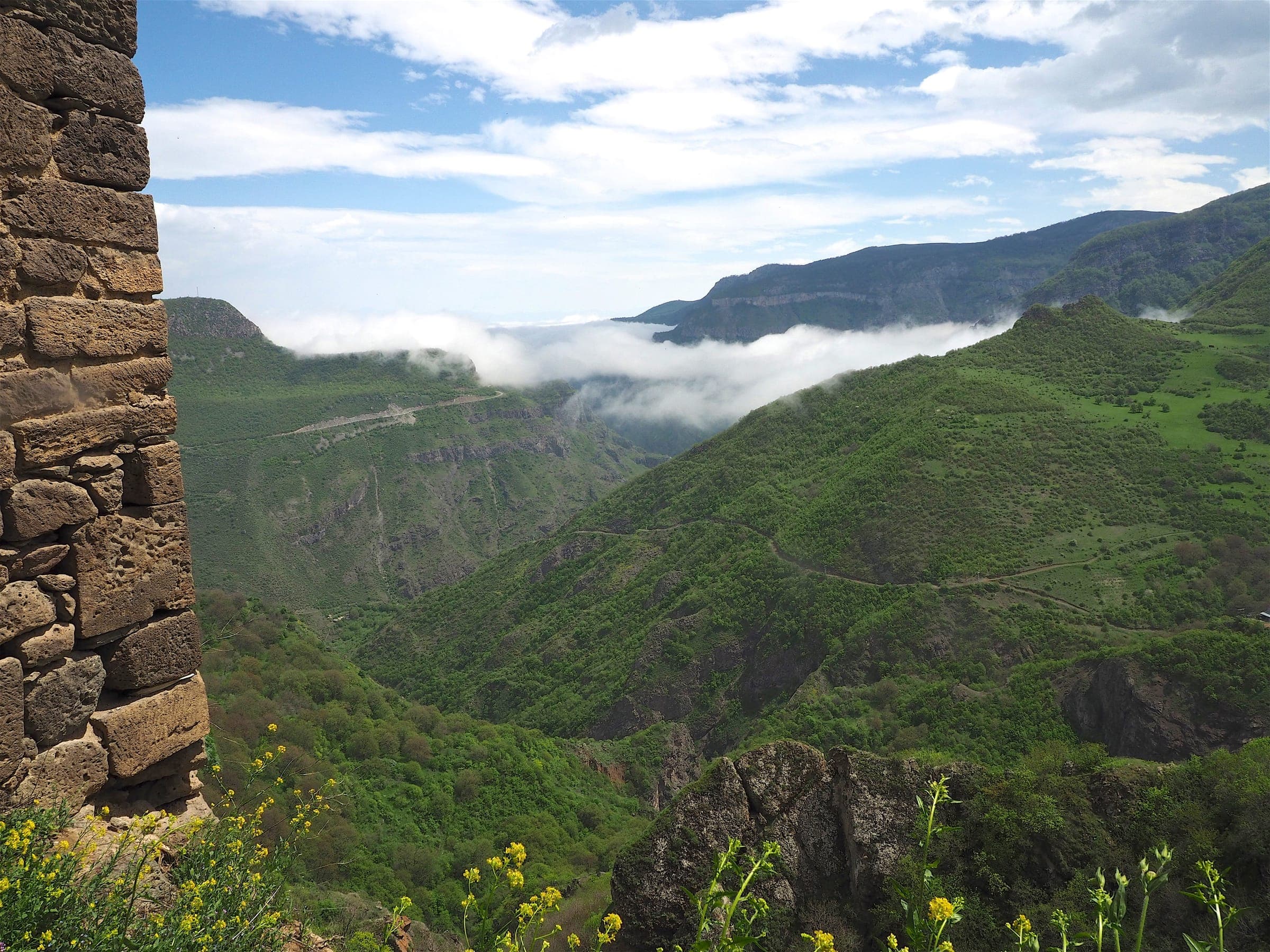
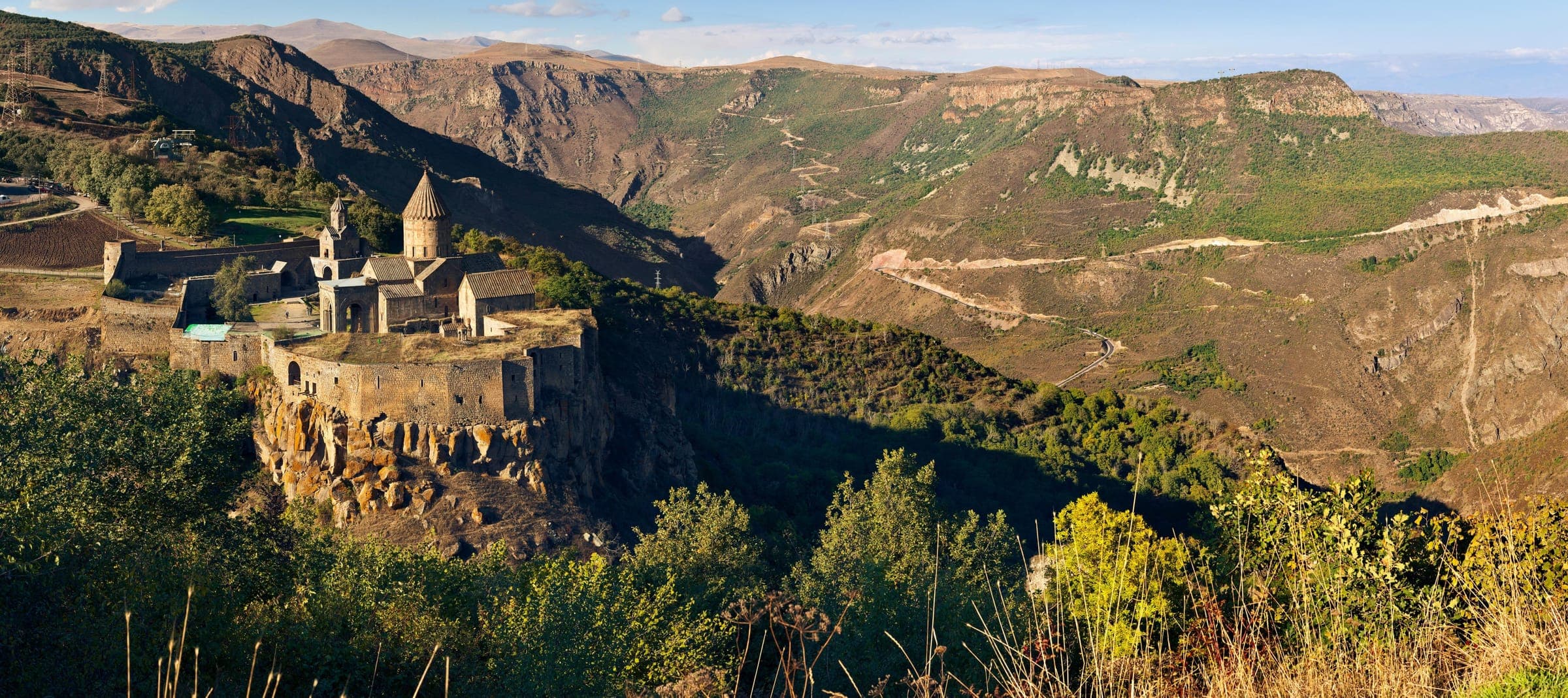
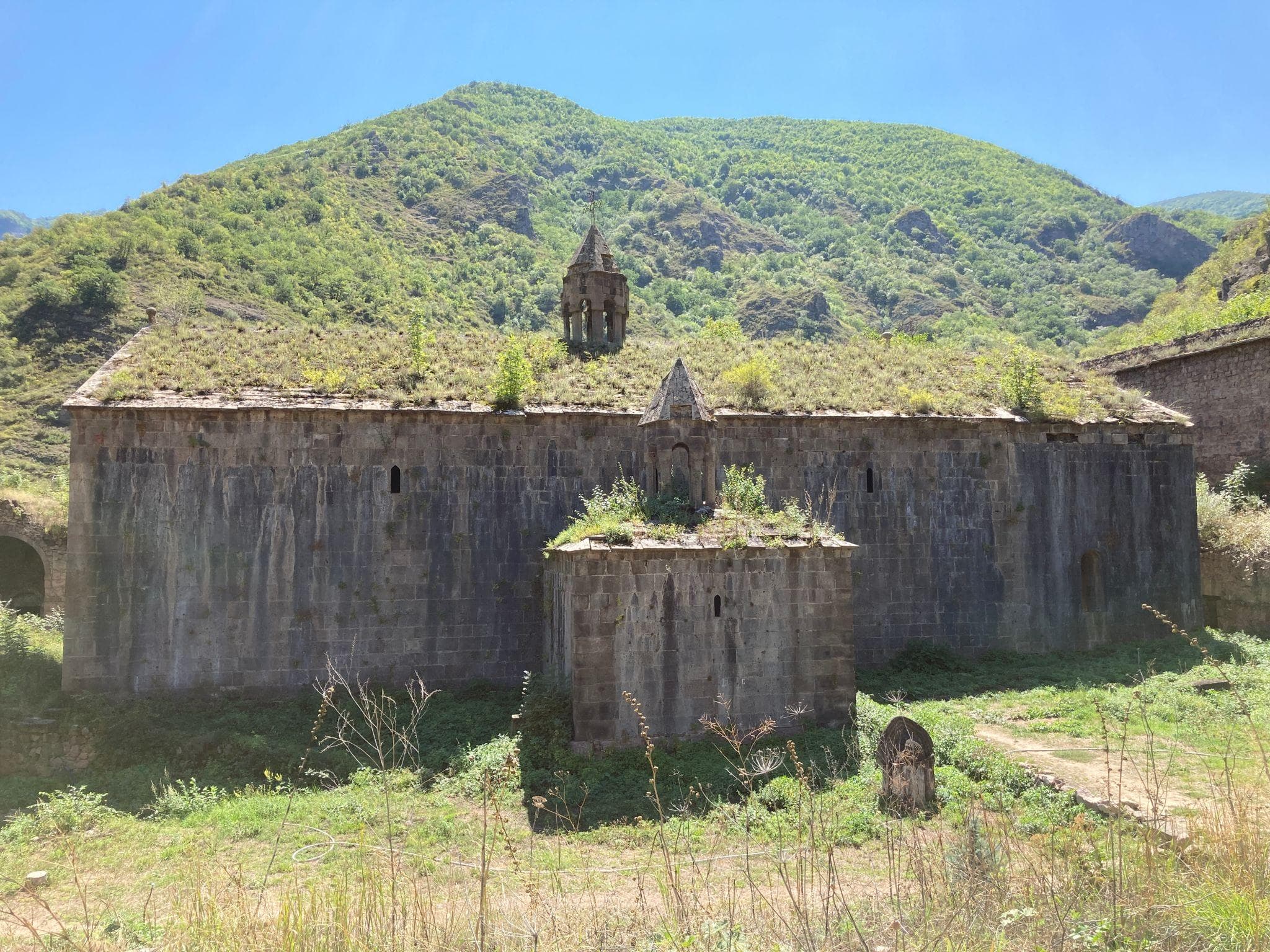
Bgheno-Noravank sits on a narrow ridge surrounded by forested ravines in Syunik Province, roughly three kilometers east of Bardzravan village and approximately six kilometers southeast of Shinuhayr. The elevation is 1,282 meters. It is a single small hall church of light-colored stone, nestled among oak trees and dense undergrowth. From the outside, the structure appears modest, yet its walls carry some of the finest relief carving of medieval Armenia. The nearest larger town is Goris.
Offroad & access
Access is via Bardzravan. From the village, a rough forest track climbs roughly three kilometers to the forested ridge. The surface is marked by potholes and considerable elevation gain; rain turns the route slippery and muddy. A 4x4 is recommended; low-range transfer is not strictly necessary in dry conditions but does not hurt. The short distance masks the actual driving time: plan the final kilometers at walking pace. This corresponds to offroad factor 3 on a scale of 5: a rough mountain track with ruts and potholes, passable but without asphalt comfort.
Type: Monastery (Cultural Site), Syunik Region. Coordinates: 39.388155 N, 46.360081 E. Elevation: 1,282 m. The present church was erected in 1062, on the site of an older stone structure dating to 963; tradition associates the rebuilding with Prince Grigor I. Ashotian of Syunik. The ruin was rediscovered in the 1920s by writer and agronomist Axel Bakunts. Nearest town: Goris. Best season: May to October. Offroad factor: 3 out of 5.
A stone church existed at this location from 963 onward. Prince Grigor I. Ashotian of Syunik had the surviving structure built in 1062. The façade reliefs—interlace patterns, pomegranate vines, and scenes from Christ's life—rank among the finest works of their age; scholars often place the sculptural mastery just behind the cross-church of Achtamar. In subsequent centuries the remote monastery fell into decay and was lost to memory. Only in the 1920s did the writer Axel Bakunts, traveling through the region as an agronomist, stumble upon the overgrown ruin and restored its name to local knowledge. The forest location gave the site strategic significance over time; the region was a focal point of Syunik's self-defense during 1919–1921.
The name Noravank means 'new monastery' in Armenian, a common designation for monastic foundations in the Middle Ages, differentiated here by the prefix Bgheno from the better-known Noravank near Areni. No widely attested independent legend is documented for this site. What has been preserved is memory of its rediscovery: According to tradition, writer Axel Bakunts found the church hidden beneath forest growth by chance during one of his walks, the rich relief decoration barely visible beneath moss and undergrowth.
Bgheno-Noravank rewards anyone seeking Armenian stonework outside the well-known monasteries. The relief carving is exceptionally dense and detailed, and the secluded forest setting usually leaves you with the place to yourself. The short but rough track from Bardzravan keeps visitor numbers low—those who arrive have made a deliberate choice. The combination of early construction, high sculptural quality, and the narrative of a forgotten and rediscovered church makes the visit genuinely compelling, not merely scenic.
Best season: May to October, when the forest track is dry and passable. Outside these months, rain or snow can make the final three kilometers extremely difficult. The starting point for access is Bardzravan; from there the track leads toward the ridge. A vehicle with four-wheel drive and reasonable ground clearance is advisable. Sturdy footwear is useful, as the terrain around the church is uneven and partially overgrown. No sanitation facilities or provisions are available on-site; bring water. The nearest larger town with accommodation and supplies is Goris.
SyunikMonastery
SyunikMountain pass
Syunik, Southern ArmeniaMonastery
Would you like to reach Bgheno-Noravank via the forest track from Bardzravan and explore this relief church at leisure? Armenia Expeditions will get you reliably to the ridge in the right 4x4 and plan your visit according to season and track conditions. One message — we’ll plan the rest.