Explorer
The Legends Route
6 days
3,300 m
Kotayk — Twenty-four black basalt columns rise from a plateau above the Azat Gorge: the only Hellenistic temple left standing anywhere in the former Soviet Union, close to two thousand years old.
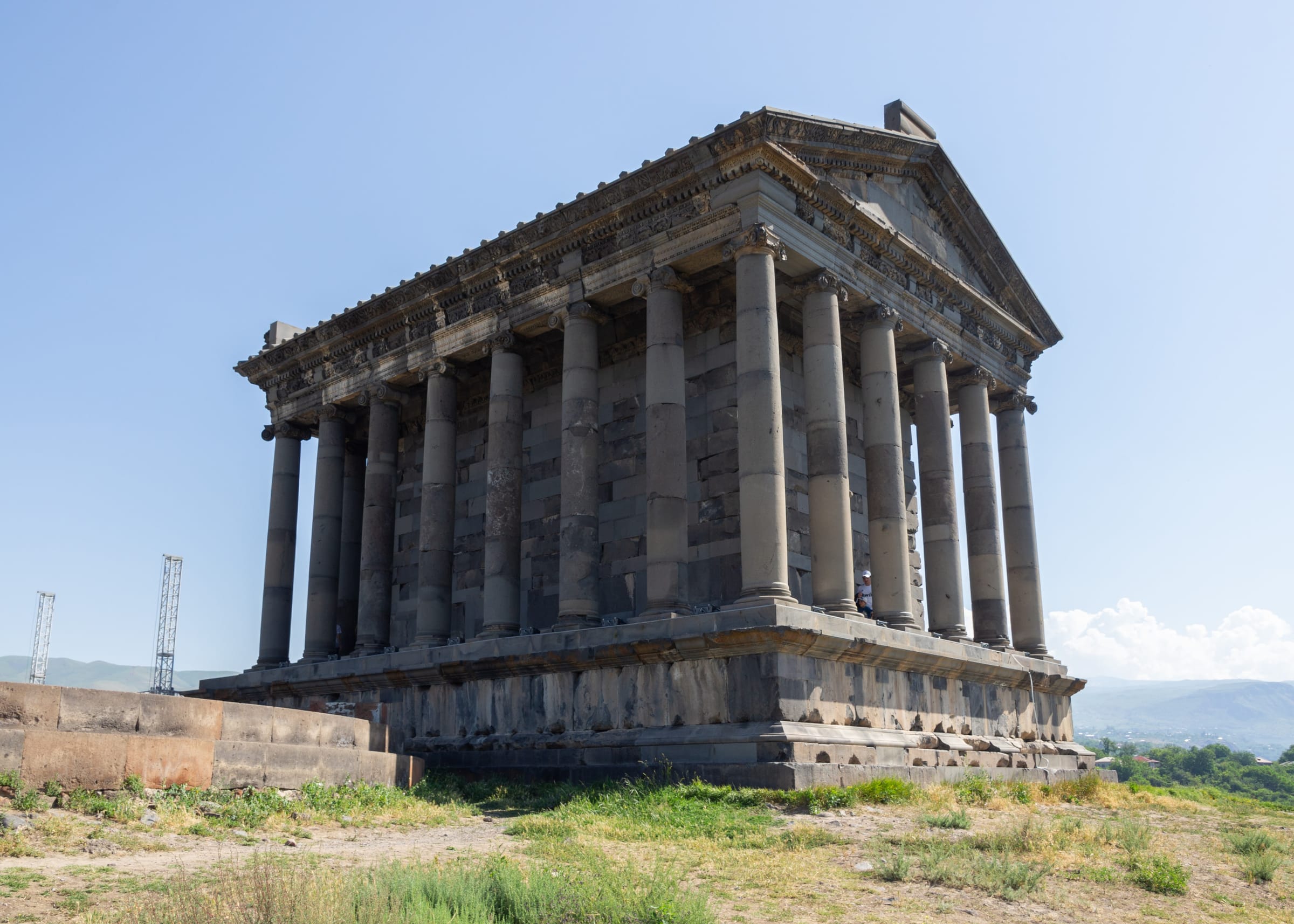
On a rock spur high above the Garni gorge stand the columns of a pagan temple — built on a Greco-Roman model, long before Armenia turned Christian. You walk between the columns, the stone warm from the sun, and below you the gorge drops steeply to the river. Behind the temple lie the walls of the old fortress that has guarded this spur since antiquity.
Twenty-four Ionic columns, dry-set from basalt blocks and joined with iron clamps, without a trace of mortar — Armenian stonework built on Roman proportion.
Offroad & access
Off-road factor 1 of 5: Garni sits on asphalt, under 40 minutes from Yerevan — no terrain, and it isn't meant to be. We set the temple as a cultural anchor between the wilder stages of your Armenia route. The real walk begins behind the temple: to see the basalt columns of the Symphony of Stones, you descend 30 to 40 minutes into the Azat Gorge, a rewarding, sometimes steep climb down.
Built around 77 AD under King Tiridates I — a Greek inscription found in 1945 names him. Likely dedicated to the sun god Mihr. The earthquake of 1679 toppled the whole colonnade, throwing debris up to 50 metres; between 1969 and 1975 the temple was raised again from original fragments and new basalt. The fortress itself reaches back to the 3rd century BC.
When Tiridates III made Christianity the state religion in 301 AD and had the pagan sanctuaries torn down, Garni alone was left standing. What the conversion spared, the 1679 earthquake threw down — the Soviet reconstruction gave the temple back its present form.
By tradition a woman saved the temple: Tiridates' sister Khosrovidukht is said to have asked him to spare this one sanctuary. The cult site became a royal cooling house, a summer residence — so it lost its pagan function without falling.
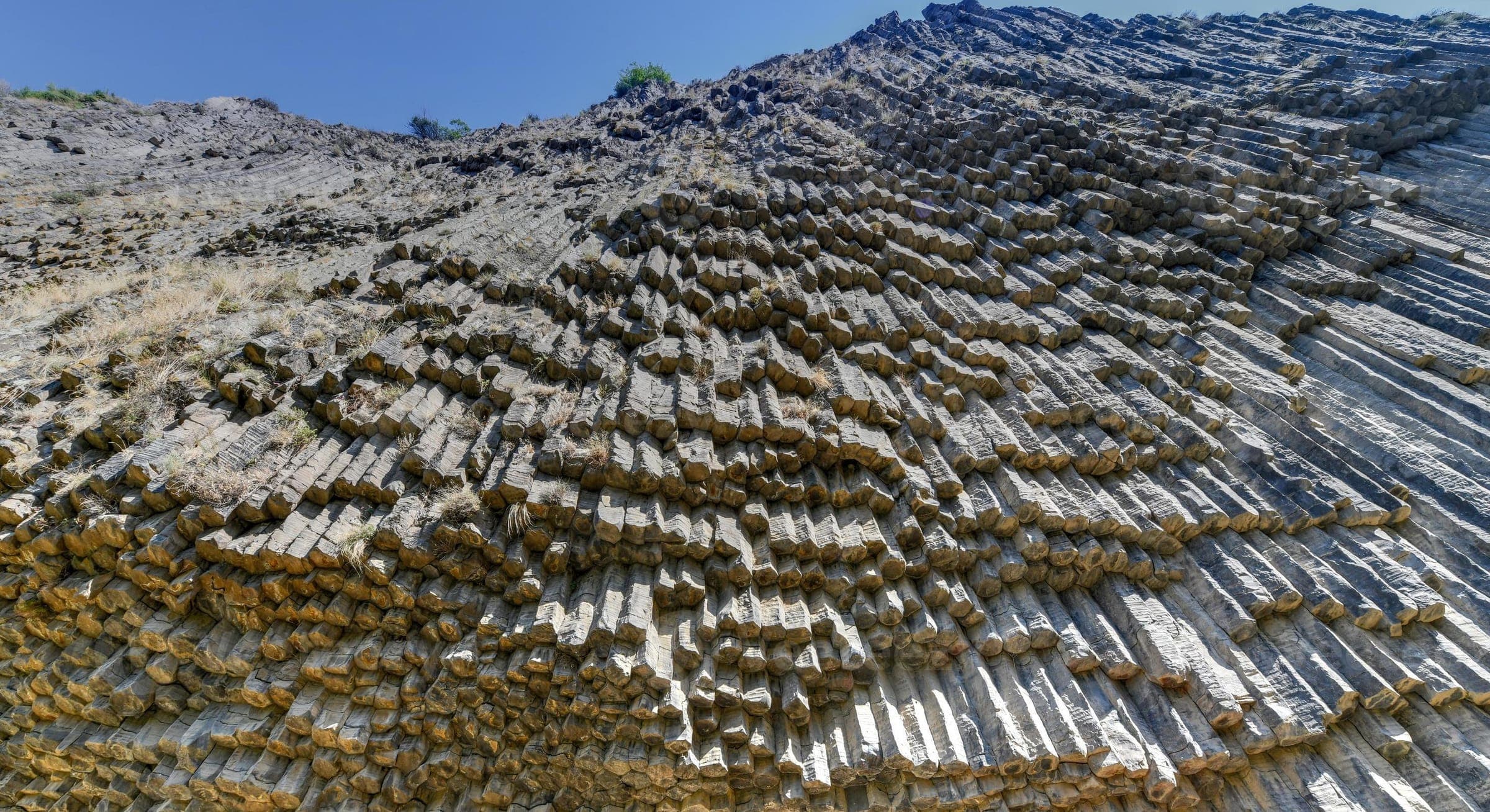
On our tours Garni stands for the other Armenia, the one before Christianity: you face the only surviving Hellenistic-Roman temple in the whole former Soviet Union. Around it: fortress walls from pre-Armenian times, a bathhouse with a mosaic floor, an Urartian inscription. And 900 metres on, the Symphony of Stones — hexagonal basalt columns up to 50 metres tall, from a lava flow around 127,000 years ago.
Access: 32 km from Yerevan on road H-3, fully asphalt, approximately 40 minutes. Parking directly at the entrance. Opening hours: daily, typically 10–18 (entrance fee as of 2025 approximately 1,500 AMD). Walk to temple: 5 minutes from parking. Descent to "Symphony of Stones": 30–40 minutes' walk into the Azat Gorge, sturdy footwear recommended. Best season: accessible year-round; spring and fall offer the most comfortable temperatures; in summer, early morning or afternoon visits encounter fewer crowds. Provisions: small stands and restaurants in Garni village, simple Armenian cuisine.
AraratFortress
Garni gorge, KotaykNature
AraratMonastery
Want to take in Garni with everything around it — fortress, temple, bathhouse, basalt gorge? The site is a fixed part of Armenia Expeditions's Armenia tours. One message — we’ll plan the rest.