Signature
Spiritual Highland
5 days
1,800 m
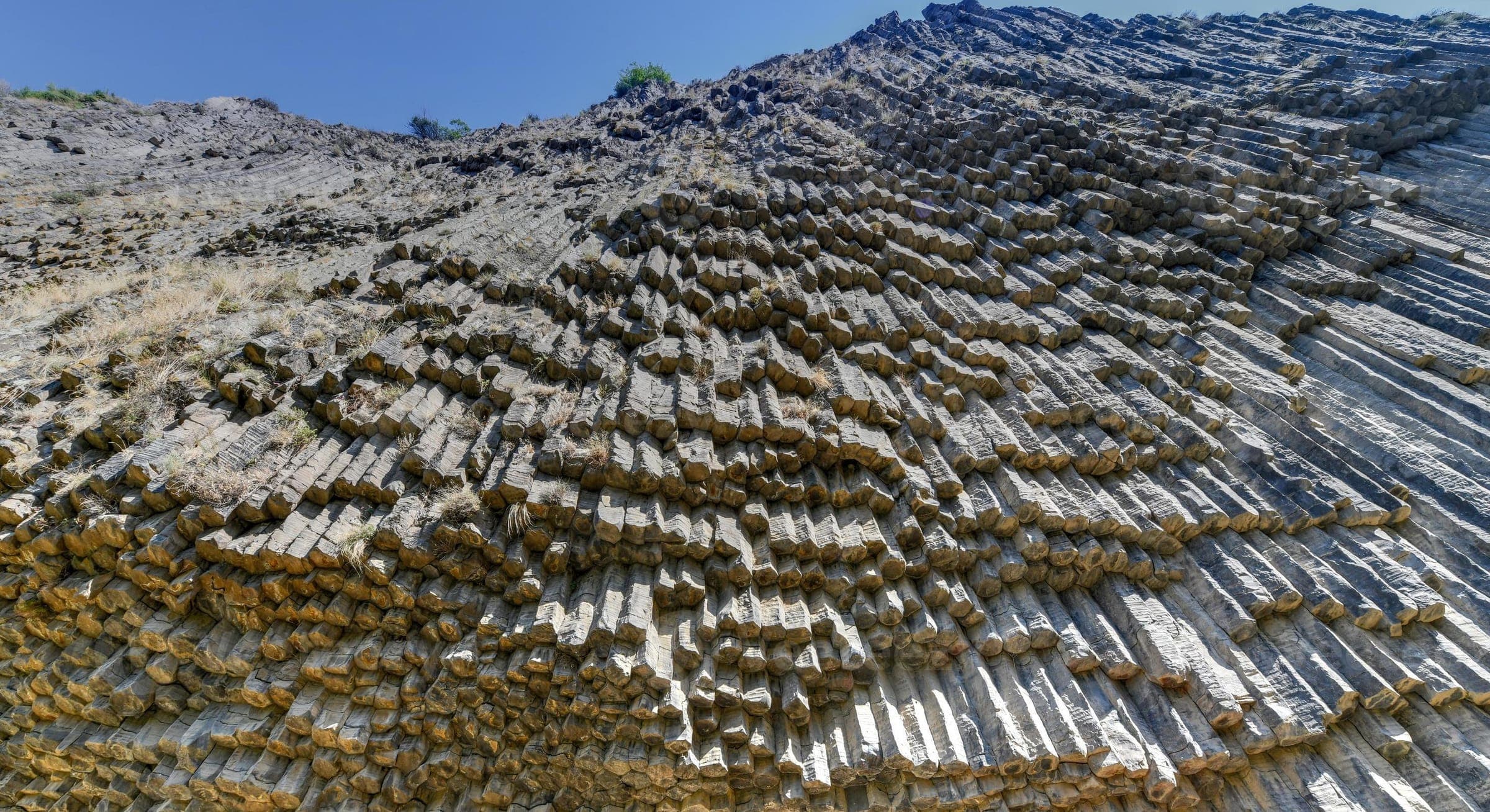
Garni gorge, Kotayk — In the Azat Gorge a wall of basalt stands in five- and six-sided columns up to fifty metres tall, so regular they look quarried and set by hand — yet no hand touched them: they are the fracture pattern of a single lava flow, some 127,700 years ago.
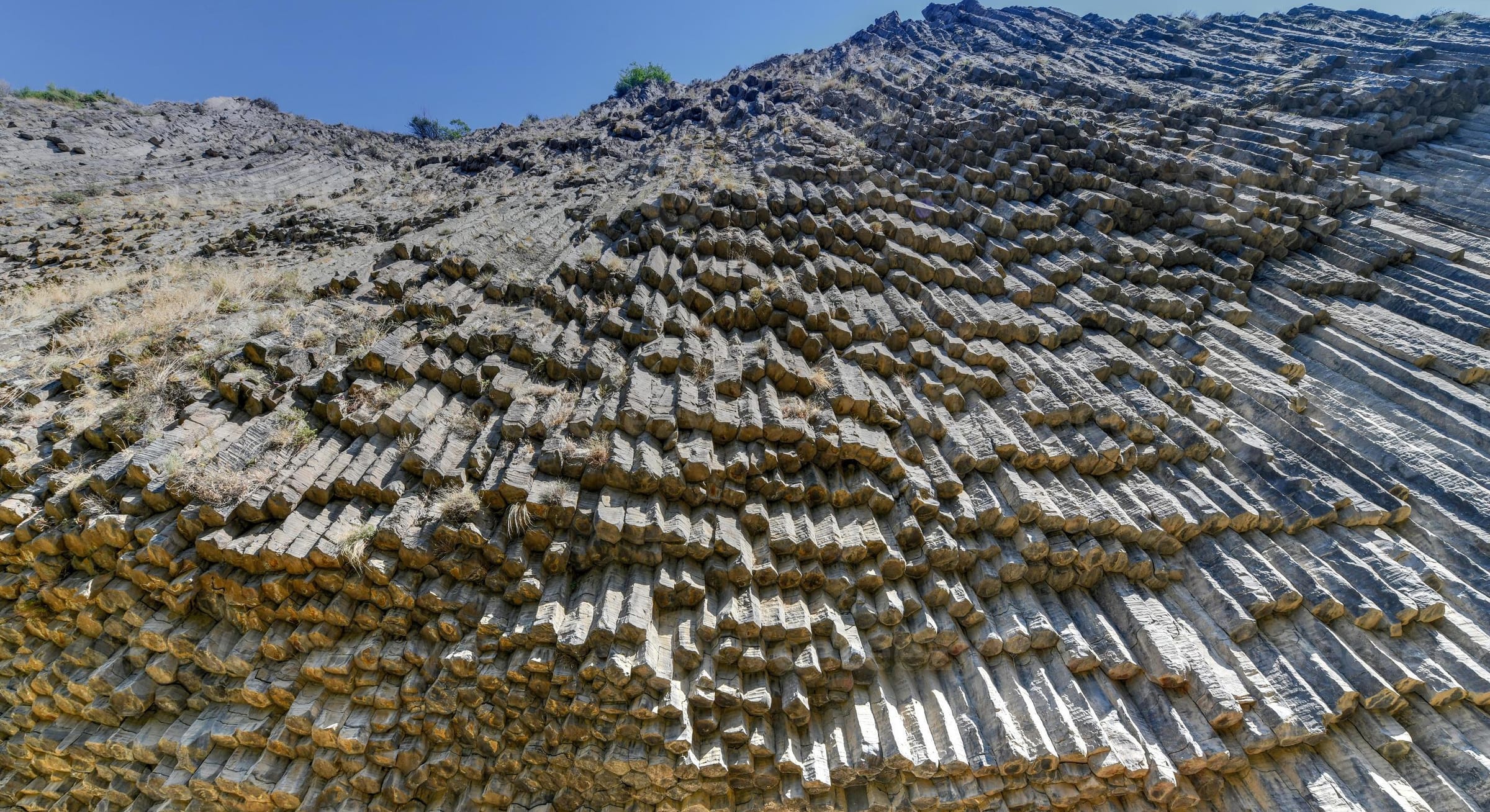
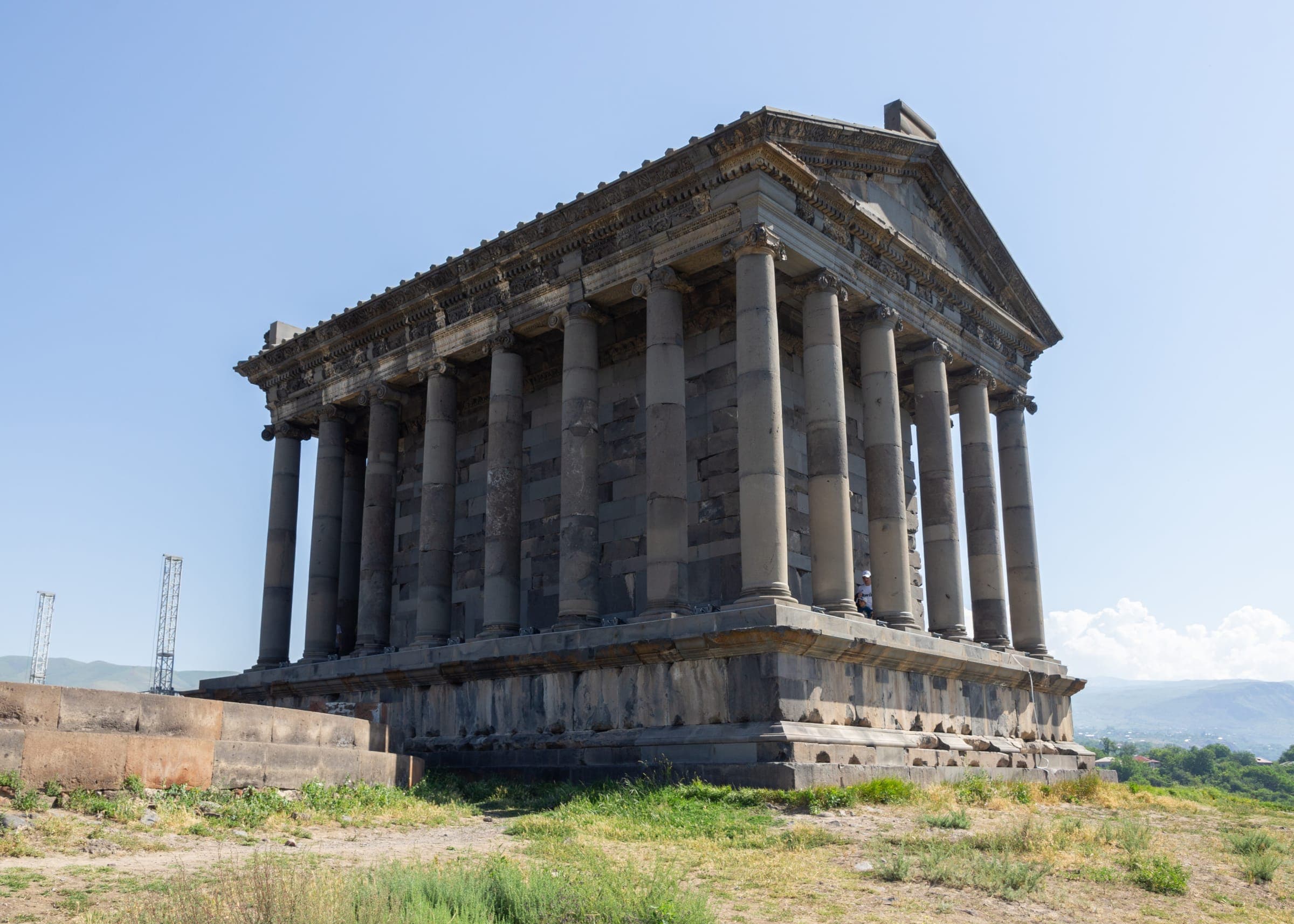
Deep in the Garni gorge, a stone's throw from the pagan temple of Garni, a wall of thousands of near-perfect hexagonal basalt columns rises up — like the pipes of a giant organ, tuned by nature herself. They formed as a lava flow cooled slowly and evenly, fracturing into regular columns as it set. Armenians call the formation the "Symphony of Stones"; standing below by the Azat river and looking up, you understand at once why.
The formation lines one wall of the Azat Gorge, a short way downstream of Garni village. A made path runs along the river to its foot, past a single-arch medieval bridge that still crosses the water. The cliff above breaks into tightly packed vertical columns — dark grey, mostly five- and six-sided, leaning and fanning where the lava bent as it cooled — with the tallest reaching around fifty metres. It is a small, self-contained place: the river below, the column wall above, the old bridge between them, taken in on half an hour's walk. Rockfall comes off the wall, so the safe line keeps a little back from the base.
Offroad & access
From Garni village the road turns to gravel — the last kilometre into the gorge is off-road factor 2 of 5, muddy after rain, and we take it in the right 4x4 where ordinary cars give up. Down at the bottom a made path runs straight to the column walls along the river. Rockfall comes off those walls, so we keep you on the safe side.
The wall over the Azat is the record of a single event. Around 127,700 years ago a lava flow poured off the Geghama Mountains and filled this stretch of valley. It cooled slowly and evenly, and as it hardened the basalt shrank and cracked from the surface inward into five- and six-sided columns — the process geologists call columnar jointing, here achieved with rare regularity and in a wall up to about fifty metres high.
The slower lava cools, the cleaner the hexagon: the columns are solidified patience.
Since then the river has done the rest, cutting down through the hardened flow and stripping away the softer rock to leave the column faces standing free above the water. In 2025 Armenia put the formation forward for the UNESCO World Heritage list, as one of the most complete exposed basalt-column flows anywhere accessible to visitors.
Human history here sits directly above the geology. On the rim of the gorge stands the Hellenistic temple of Garni, which King Trdat I dedicated to the sun god Mihr in the 1st century AD; after Armenia adopted Christianity in 301 the temple was spared and kept on as a royal summer residence rather than pulled down. The gorge itself carried a road and a crossing through the medieval centuries: a single-arch stone bridge, cut from the same basalt as the columns, still spans the Azat on the valley floor and is usually dated to around the 11th century. So the site layers a natural formation more than a hundred thousand years old, a pagan temple close to two thousand years old, and a medieval bridge — each worked in the same black stone, and all within a few hundred metres of one another.
Long before geology had a word for it, the wall needed explaining, and the people of the gorge gave it two names. The older is grim: they called the columns the "Devil's Beehives," because the packed hexagons stack like the cells of a honeycomb, and because something this ordered, rising sheer out of a cliff, seemed beyond ordinary making — the kind of work a place lays at the devil's door when it has no other account of it. The second name is modern and kinder. Hearing the ranked columns as the pipes of an organ, Armenians renamed the formation the "Symphony of Stones," and that is the name that has stuck. Neither is a legend with a plot so much as a way of reading the rock: one sees a demon's handiwork, the other an instrument, and both are trying to explain the same impossible regularity.
A lava flow preserved this completely, and exposed this cleanly, survives in only a handful of places on Earth — the Giant's Causeway in Ireland, Fingal's Cave in Scotland, Devil's Tower in Wyoming. Armenia's is far less known and, for now, far less managed: no railings, no ticket queue, just a river path that leads to the foot of the columns. That is the appeal. You can walk right up to the base of a fifty-metre wall of basalt prisms and take its full scale in without a crowd between you and the rock. Reaching the gorge floor means a short rough drive and a walk most day-trippers skip, which keeps it quiet even when the temple above is busy. We give it time as a natural set-piece in its own right, not a two-minute photo below the temple car park.
From Garni village the road drops toward the gorge and turns to gravel; the last kilometre in is off-road factor 2 of 5, rutted and muddy after rain, so a higher-clearance vehicle earns its keep where ordinary cars turn back. On the valley floor a made path runs along the river to the columns — level and short, a few minutes on foot. Loose rock comes off the wall, so keep back from the base and stay on the path. The gorge is reachable year-round, but May to October is the reliable window; after heavy rain the track and the riverside both turn greasy. Allow about half an hour to walk in, look, and walk back.
AraratFortress
KotaykFortress
AraratMonastery
Armenia Expeditions brings you into Garni Gorge in the right vehicle — with time to explore the column walls unhurried. One message — we’ll plan the rest.