Explorer
Volcanoes & Geysers
5 days
3,300 m
Vayots Dzor — At 2,410 meters, just below the Vardenyats Pass summit, stands an elongated basalt structure from 1332. The Selim Caravanserai sheltered merchants and pack animals on the trade route between Dvin and Partav. Three stone inscriptions name the builders from the Orbelian house. You can reach it directly from the pass road.
Light falls only through round openings in the ceiling of the three-aisled hall, where seven pairs of pillars once carried the roof and stone troughs watered the pack animals. In the inscription on the east wall, the builders recorded that they had raised the house "for the salvation of their souls" — a pious endowment, not merely a waystop. Today the hall stands empty, and the silence weighs heavier than the basalt vault above you.
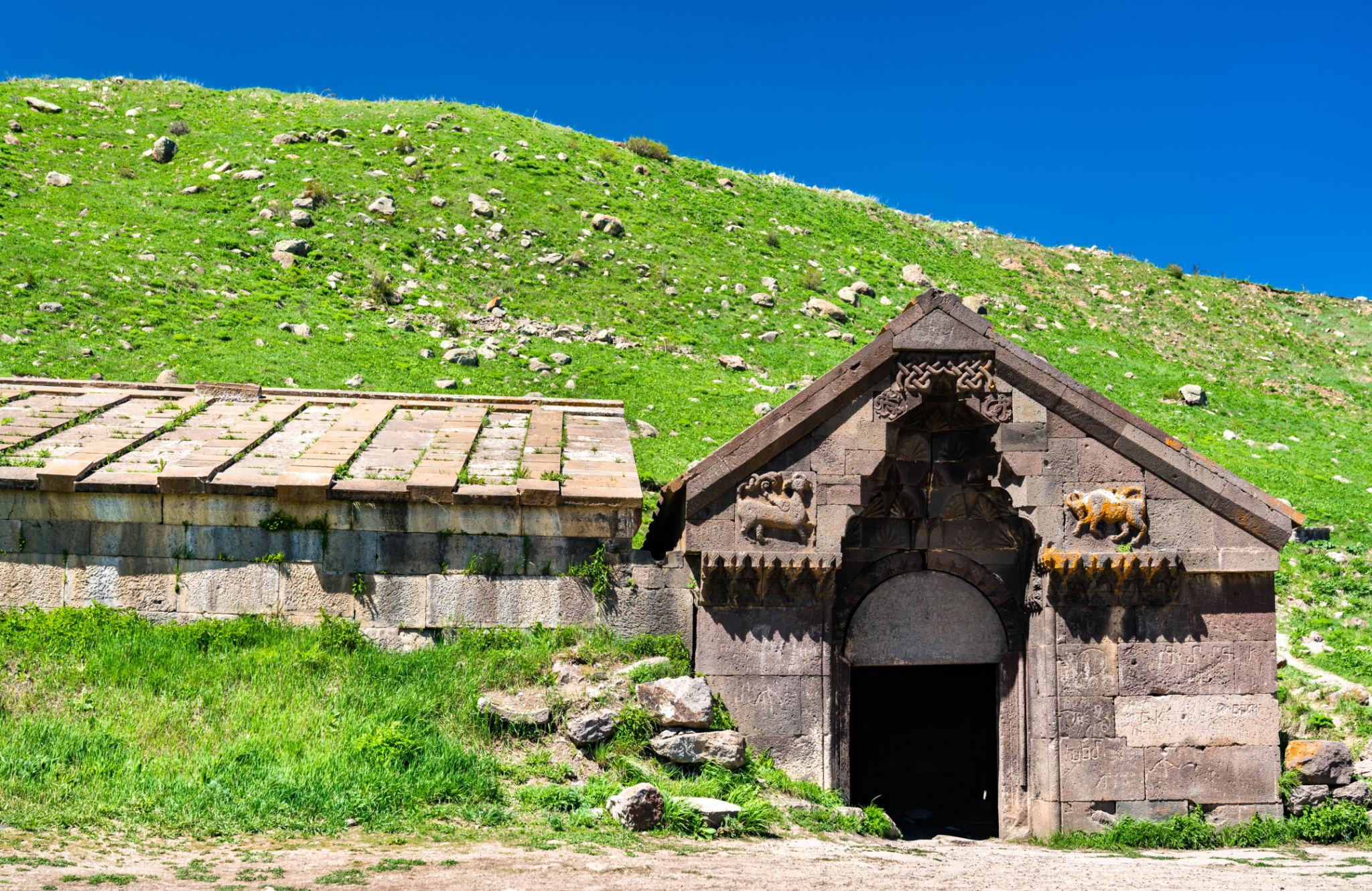
The Selim Caravanserai lies on the southern slope of the Vardenyats Pass (also called Selim Pass) in Vayots Dzor province, somewhat below the pass summit at 2,410 meters. From outside, the structure appears low and compact: a 41-meter-long ridge of dark basalt blocks, nestled into the slope, with a single portal on the south side. All around stretches treeless highland steppe, covered by snow from late autumn onward. When you pass through the gate, you enter a cool, dim hall lit only by circular openings in the ceiling.
Offroad & access
Access is straightforward: a continuously paved serpentine road climbs the Vardenyats Pass and ends virtually at the building. Off-road factor 1 — no all-terrain vehicle is needed to get here. However, the asphalt is marked in places by potholes and frost damage, and the tight switchbacks demand focused driving at altitude. The pass is closed in winter and tends even in warmer months to sudden fog that severely restricts visibility in the curves. Plan your drive in clear weather, ideally in the morning.
Built in 1332 by Tschesar Orbelian, son of Prince Liparit, together with his brothers Burtel, Smbat and Elikum, and his wife Khorishah. The structure is made of basalt and measures 41 meters in length. The interior forms a single hall divided by seven pairs of pillars into three aisles; three parallel barrel vaults support the roof, circular openings provide light and air. Between the pillars lie stone troughs for animals, and on the west side a separate room for travelers. Three inscriptions survive: an Armenian one on the east wall, plus remains of Persian and Arabic inscriptions at the entrance. Above the lintel sit two reliefs: on the left a winged creature, on the right a bull. Location: 39.9495 N, 45.23667 E. Best travel season: June to October.
The caravanserai stood on the medieval trade route between Dvin and Partav, a section of the network linking southern Caucasus with Lake Sevan and beyond. Here merchants rested with their camel and mule caravans, found shelter from weather and cold, and could feed and water their animals. The patron was the Orbelian princely house, which ruled Vayots Dzor at the time; the portal reliefs bear the dynasty's heraldic marks. In the 15th and 16th centuries the building fell into ruin as trade routes lost their importance. Between 1956 and 1959 it was restored and today ranks among Armenia's best-preserved caravanserais. An archaeological survey in 2014 refuted the earlier assumption that a church had stood beside the structure.
This place has not preserved a distinct legendary figure. What is instructive instead is the Armenian building inscription itself: According to tradition, the Orbelian brothers erected the house in 1332 explicitly 'for the salvation of their souls' and those of their family — the waystop was thus conceived as a pious endowment, not merely as a utilitarian building. The two reliefs above the portal, the winged creature and the bull, are connected with the dynasty's visual language; their precise meaning remains unclear.
Few medieval secular structures of the Silk Road survive as completely as this one. You step into a substantially original stone hall from 1332 in which the principle of a caravanserai is immediately readable: the animal troughs, the ceiling light openings, the separate human quarters. Add the elevation at 2,410 meters with the view across open highland steppe. Once you have seen the dated inscription on the east wall and the reliefs above the portal yourself, you grasp the history of this trade route more concretely than any description could convey.
Reach via the paved Vardenyats/Selim Pass road; the building sits directly on the road just below the pass summit. Nearest towns are Selim and Yeghegis. Best season is June through October — the pass closes in winter. The interior is cool and dim; a flashlight helps reveal the inscriptions and reliefs. Sturdy shoes are wise, as the floor is uneven. At altitude, wind is frequent and weather changes rapidly; bring a windproof jacket. There is no supply on site; plan your own water and provisions.
Vayots DzorGeyser
Vayots DzorMonastery
Vayots DzorFortress
Would you like to experience the Selim Caravanserai at Vardenyats Pass on a guided drive? Armenia Expeditions takes you to the pass summit and allows time on-site for inscriptions, reliefs, and the story of this Silk Road structure. One message — we’ll plan the rest.