Signature
Spiritual Highland
5 days
1,800 m
Ararat — At 950 meters elevation, nestled between shale slopes and wormwood steppes, lies a 175-hectare expanse of sandy desert entirely absent elsewhere in the South Caucasus: the Goravan Sands State Reserve, sited directly at the village of Goravan in Ararat Province.

The Armenian tortoise pushes through the summer heat here, and the trumpeter finch seeks shade among Paleozoic limestone ridges. Layers of diatoms in the sand tell of a time when a lake or shallow sea stood here and the Ararat basin still held water. The desert shrub Calligonum polygonoides forms its only complete ecosystem anywhere in the South Caucasus here — its closest relatives grow again only in the Thar Desert.
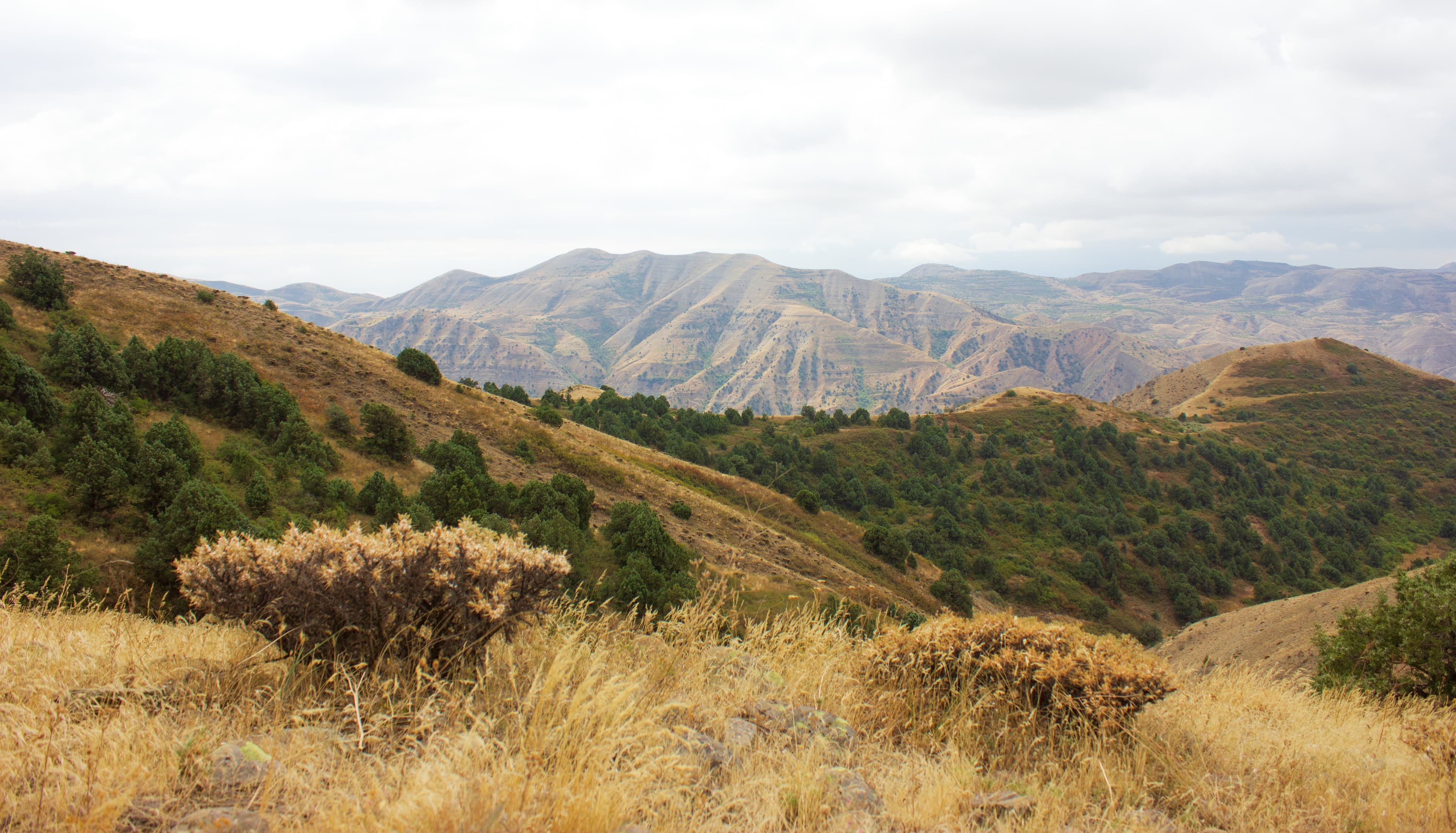
The Goravan Sands Reserve occupies the northwestern flank of the Urtz mountain range, on the left bank of the Vedi River, at elevations between 894 and 1,060 meters. What distinguishes this place is contrast: sandy depressions, Paleozoic limestone ridges, interspersed with low-growing thorn scrub. Vegetation is sparse and precisely adapted to annual precipitation of 200–300 millimeters and summer temperatures reaching 42 °C. The reserve protects the largest known remnants of a sandy semi-desert in Armenia and simultaneously hosts the only complete occurrence of the desert shrub Calligonum polygonoides across the entire South Caucasus—a relict population whose nearest kin dwells in India's Thar Desert.
Offroad & access
Offroad rating 2 out of 5. Access follows paved rural road to Goravan, then well-trodden gravel and field paths directly to the reserve. In dry conditions, the terrain is reachable by standard passenger vehicle; loose sand occurs sporadically off marked routes, requiring caution. All-wheel-drive provides greater flexibility exploring the margins, though not required. The viewing area is flat to gently rolling; no significant grades or fords. Drive time from Yerevan approximately 45–55 minutes (roughly 35–40 km south via Vedi). Recommended on-site duration: 1–2 hours, depending on botanical and reptile-watching interests.
Area: approximately 175 hectares (nominally 200 hectares total reserve, mapped since 2005/2006 across over 10 sand patches). Established 1959 by the Armenian Soviet Socialist Republic government; since 2007 administered under the Khosrov Forest Reserve. Elevation: 894–1,060 m above sea level. Coordinates: 39.8505° N / 44.7381° E. Annual precipitation: 200–300 mm, mean annual temperature +12 °C, temperature extremes −25 °C to +42 °C. Flora: approximately 160 vascular plant species, 12 on Armenia's Red List, including Calligonum polygonoides (phog), which here constitutes the sole complete ecosystem across the South Caucasus, and Fritillaria gibbosa (recorded in Armenia only here). Fauna: at least 36 vertebrate species, including 13 reptile taxa; 7 species on Armenia's Red List, including Phrynocephalus horvathi (Horvath's sun-watcher lizard), Eremias pleskei (Transcaucasian runner), Testudo graeca armeniaca (Armenian tortoise), and the trumpeter finch (Bucanetes githagineus). WWF Caucasus Biodiversity Hotspot, IUCN protection category IV.
The reserve was established in 1959 at the behest of the Armenian Soviet Socialist Republic Academy of Sciences, following field studies documenting the extent of sand remnants and their unique flora and fauna. The geological substrate comprises Paleozoic limestone overlaid by Pleistocene sand deposits and Tertiary clay layers—evidence of an ancient lake or shallow sea, attested by diatom-rich sand strata. The village of Goravan itself bears a name of Turkic-Urartian origin: the element "kora" in Old Turkic means roughly "cattle enclosure" or "farmyard," combined with the Armenian suffix "-avan" (settlement, place), itself derived from Urartian "abani" (land, place). In 1944 the village was renamed "Yenikend" by decree; however, the historical name Goravan was restored in 1968. After Soviet collapse, the reserve suffered decades without formal management, facing pressure from overgrazing, sand mining, and unauthorized use—conditions field studies from 1998–2008 documented in detail.
No specific oral tradition directly concerning Goravan's sand fields is attested in scholarly or ethnographic literature. The village name suggests, however, that the region has served for centuries as pasture and settlement—the sand fields traditionally regarded as marginal, uneconomic land rather than a mythically laden site. Ancestral communities, oral tradition holds, used roots and branches of the phog shrub (Calligonum polygonoides) as fuel and harvested steppe herbs like yarrow (Achillea tenuifolia) for food and medicinal purposes—a practice documented to the present and explaining persistent vegetation pressure.
Goravan Sands is the South Caucasus's sole complete desert ecosystem. To observe reptile species otherwise found only in the Thar Desert or the Iranian Plateau—among them sun-watcher lizards of the genus Phrynocephalus—represents the northernmost and westernmost range limit of these taxa. The phog shrub, Calligonum polygonoides, nowhere else in the Caucasus beyond Iran and the Indian subcontinent exists within a complete growth community. The landscape itself is unspectacular in dramatic sense—those valuing clean lines, quiet sand surfaces, and concentrated biodiversity in tight quarters will find more than anticipated.
Best travel season: March to May (spring bloom, temperate conditions) and September to November (autumn, reptiles still active). Summer (June–August) is extremely hot, to 42 °C; early morning hours recommended. Access: from Yerevan southbound via M2 to Vedi (approximately 35 km), then local road to Goravan (approximately 3–5 km); from there gravel or field path to reserve. Parking available at edge. Entrance: no formal ticketing system known; reserve falls under Khosrov Forest Reserve administration. Equipment: sturdy footwear, sun protection, ample water (no on-site infrastructure). Photography: optimal conditions with diffuse light early morning or evening for reptiles and plant details. Mobile reception limited in area.
Ararat plainMonastery
AraratReserve
KotaykFortress
Goravan Sands Reserve is no marked tourist trail. Armenia Expeditions directs you to locations of scientific significance and rarely visited. Should you wish to experience this piece of desert in the Ararat Basin along your route, contact us. One message — we’ll plan the rest.