Signature
Spiritual Highland
5 days
1,800 m
Vagharshapat — A low, broad-domed church in a walled garden of roses and archways — the seat of the Catholicos of All Armenians, and a church that counts its history from the year 301. It stood closed for six years while it was rebuilt from the ground up; on 29 September 2024 it was consecrated anew.
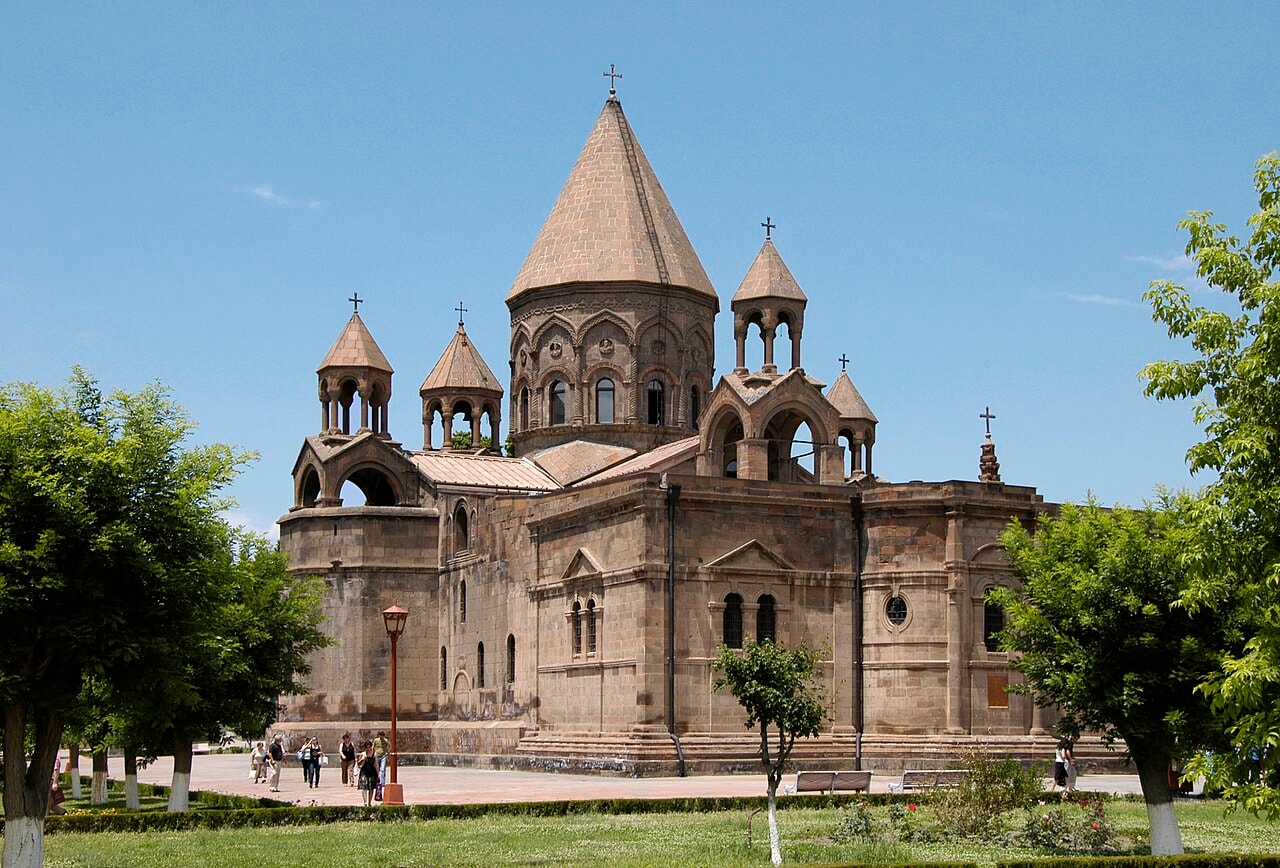
Traditionally founded in the early 4th century, Etchmiadzin is regarded as the oldest cathedral in the world and remains the spiritual heart of the Armenian Apostolic Church. Incense hangs in the air, chant fills the stone vault. Together with the nearby 7th-century ruins of Zvartnots, it is a UNESCO World Heritage Site.
The name carries the whole story: Etchmiadzin means the descent of the Only-Begotten, and it records a vision rather than a building contract. What stands on the square today is the work of many centuries — the ground plan of 483/484, the bell towers of the 17th century, the paintings of the 18th. Beneath the floor lie the remains of a pre-Christian sanctuary.
Offroad & access
Off-road factor 1 of 5: Etchmiadzin sits on asphalt, barely 20 kilometres west of Yerevan — no terrain, and none is wanted here. We usually hang the cathedral on the first or the last day, when the route crosses the Ararat plain anyway and the tracks of Vayots Dzor and Syunik are still ahead of you or already behind. The car stops at the edge of the monastery yard, and the rest is a walk across gravel and lawn. A few kilometres along the same road stand the ruins of Zvartnots.
By the tradition of the Armenian Apostolic Church the cathedral was raised between 301 and 303 under Gregory the Illuminator. The shape of the present building goes back to 483/484, when Vahan Mamikonian rebuilt the church after a Persian invasion had badly damaged it. From 1627 Catholicos Movses III had the dome, ceiling, roof, foundations and paving repaired; the western bell tower went up in 1654–1658, the smaller belfries in 1682, the sacristy in 1868 under Catholicos Gevorg IV. Naghash Hovnatan painted the interior between 1712 and 1721. The cathedral stands at Vagharshapat in Armavir Province, 18 kilometres west of Yerevan; Zvartnots airport lies 10 kilometres east of the town. Since 2000 it has been part of the UNESCO World Heritage Site Cathedral and Churches of Echmiatsin and the Archaeological Site of Zvartnots.
The building becomes tangible in the 5th century: in 483/484 Vahan Mamikonian raised the ruined church again, and it is from that work that the cross plan with its central dome in front of you descends. Excavations below the floor uncovered the remains of a pre-Christian sanctuary, most likely a fire altar. In 1441 an assembly of several hundred clerics voted to bring the catholicosate back here; Etchmiadzin has been the seat of the Catholicos of All Armenians ever since, and only in the 15th century does the present name come into use. From 1627 Movses III renewed the dome, roof and foundations, the bell towers followed, and from 1712 to 1721 Naghash Hovnatan painted the interior. In 2000 UNESCO inscribed the cathedral together with the town's other churches and the ruins of Zvartnots. From 2018 to 2024 it stayed shut: foundations, piers, arches, the cross on the dome and more than 600 square metres of frescoes were made good — the first intervention on that scale since the 1620s.
The name of the place comes out of a vision, not out of a builder's record: Christ is said to have appeared to Gregory the Illuminator and to have struck the ground with a golden hammer, marking the spot where the cathedral was to stand. Hence Etchmiadzin — the descent of the Only-Begotten. The building dates 301 to 303 are handed down by the church as tradition too; what the fabric attests is the rebuilding of 483/484. Older sources call the place simply the cathedral of Vagharshapat, and the name Etchmiadzin appears only in the 15th century.
On our tours Etchmiadzin is where the Armenian church is not the past but administration, training and worship: the same walled yard holds the cathedral, the seminary and the residence of the Catholicos. Every seven years the Holy Muron is blessed here, the chrism of the entire Armenian church — most recently on 28 September 2024, a day before the cathedral was consecrated anew. The treasury holds the relics on which the country's piety hangs, among them the Holy Lance in its silver reliquary and a splinter that tradition ascribes to Noah's Ark. And since the restoration the paintings show colours that lay under soot for decades.
Access: barely 20 kilometres west of Yerevan, asphalt the whole way; by public transport, minibuses 202 and 203 leave Kilikia bus station roughly every 30 minutes. Entry to the cathedral is free, the treasury charges — sources give its opening hours differently, so ask on site. Dress: legs covered, men take off their headgear; the women of the parish wear a headscarf, visitors are not asked to. The cathedral is a working church, consecrated again on 29 September 2024: during the liturgy you keep to the side and leave the camera down. Zvartnots lies a few kilometres along the same road towards Yerevan and fits into the same day.
AragatsotnFortress
AragatsotnMonastery
AragatsotnLake
Want to stand in the yard from which the Armenian church has been led since the 15th century? Etchmiadzin is a fixed part of Armenia Expeditions's Armenia tours. One message — we’ll plan the rest.