Gravel
near Sisian, SyunikNature
Syunik — A monastery complex from the year 1000 stands on a narrow ridge high above the Vorotan Gorge, encircled by walls like a fortress. Queen Shahandukt of Syunik commissioned its construction; a subterranean passage once linked it to a nearby stronghold. You reach Vorotnavank via a narrow mountain road through the gorge, away from main routes.
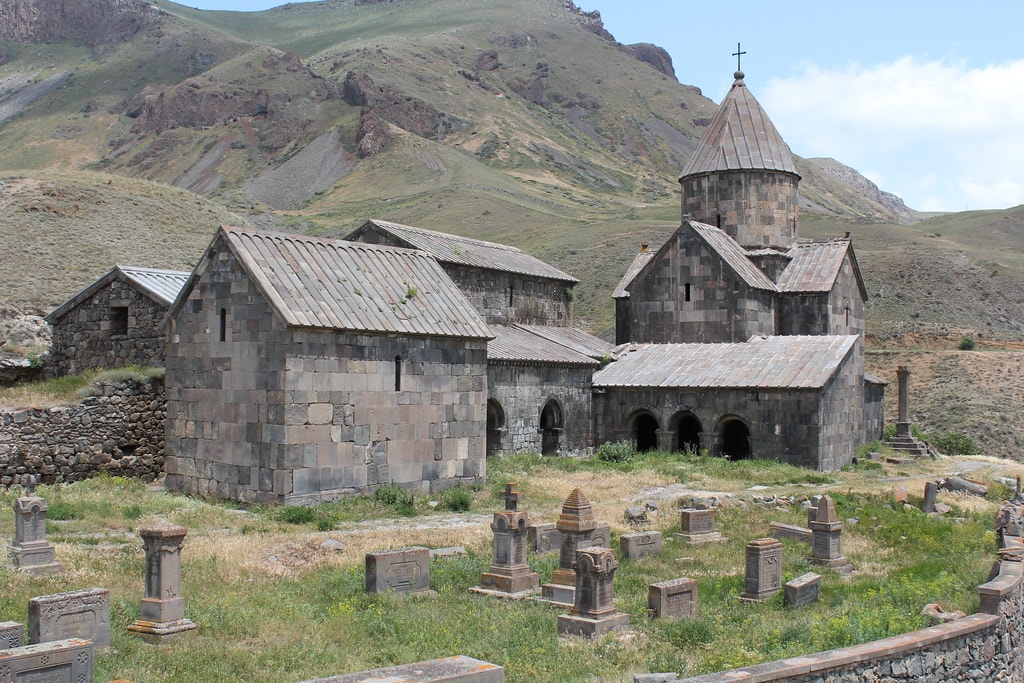
The church’s stones are said to cure snakebites, so tradition holds – a belief that persists to this day, even though no one can prove it. In the 14th century, the scholar Hovhan Vorotnetsi taught here before founding the famous academy at Tatev. After the 1931 earthquake, the dome of the Church of the Holy Apostles lay in ruins; only from 1980 did rebuilding begin.
Vorotnavank rises on a narrow rocky ridge above the Vorotan Gorge, roughly 14 kilometres east of Sisian between the villages of Wagatin and Vorotan. At 1450 metres elevation, greyish-brown tuff walls and cone-shaped drum churches stand out against the slope. A continuous stone wall encloses the complex, giving it the character of a fortified enclosure to this day. The terrain drops sharply downward to the river below.
Offroad & access
The approach from Sisian follows a narrow mountain road through the Vorotan Gorge to the monastery. The surface alternates between asphalt sections and gravel; the final stretch is partly unpaved and confined, with cliff edges. In dry weather, the route is passable in a standard sedan with normal ground clearance; four-wheel drive is not essential. After rain, gravel may become soft and slippery. The final curves demand careful driving because oncoming traffic requires room to pass. Travel time from Sisian is roughly 20 to 30 minutes.
Region: Syunik. Type: Monastery (10th–11th centuries). Elevation: 1450 m. Coordinates: 39.4956, 46.1222. Nearest town: Sisian (approx. 14 km). Best season: April to November. Core structures: Church of St. Stepanos (1000, commissioned by Queen Shahandukt of Syunik) and Church of the Holy Apostles (1006–1007, built by her son Sevada); also a chapel dedicated to Gregory, a columned hall, a guesthouse, and a cemetery within the enclosure wall. Offroad factor: 2 out of 5.
The present complex dates to the year 1000, when Queen Shahandukt of Syunik endowed the Church of St. Stepanos. Between 1006 and 1007, her son Sevada added the adjacent Church of the Holy Apostles. Vorotnavank was for centuries an important spiritual and scholarly centre of Syunik; in the 14th century, the theologian and philosopher Hovhan Vorotnetsi (1315–1398) worked here and later founded the academy at Tatev. The enclosure wall provided defence against raids; a subterranean passage once connected the monastery to the nearby stronghold of Vorotnaberd. An earthquake in 1931 collapsed the dome of the Church of the Holy Apostles; restoration work began in 1980.
According to tradition, a chapel stood at this site in the 3rd century, supposedly built by Gregory the Illuminator and later renewed by a hermit named Stepanos, from whom the main church takes its name. Local legend holds that stones from the church possessed healing properties against snakebites. These accounts lack verification and belong to oral tradition associated with the place. The name Vorotnavank refers to its location above the Vorotan River and the stronghold of Vorotnaberd in the gorge.
Vorotnavank combines two qualities rarely found at the same Armenian location: a fully walled monastery complex from around 1000 and an exposed position directly above a deep gorge. Unlike the heavily visited monasteries of the region, it remains quiet; often you are alone with the wind and the sound of the river. Those interested in medieval fortified architecture, Shahandukt's patronage, or traces of Vorotnetsi will find concrete substance rather than mere backdrop. The drive through the gorge is part of the experience.
Best time: April to November; in winter the mountain road may become difficult due to snow or ice. Access: from Sisian approximately 14 km east through the Vorotan Gorge, about 20 to 30 minutes. Sturdy footwear is recommended; the terrain on the ridge is uneven and partly unsecured. Move carefully along gorge edges. Admission is typically free. No facilities on-site; bring water and provisions. Plan about one hour for the complex and surrounding views.
near Sisian, SyunikNature
near Sisian, SyunikArchaeology
SyunikLake
Do you wish to reach Vorotnavank via the gorge road and experience the monastery complex at your own pace? Armenia Expeditions guides you on the appropriate route and schedules your approach and stay according to your preferences. One message — we’ll plan the rest.